Verdi Requiem
March
19, 2005
OperaOnline
By Paul Joseph Walkowski, OperaOnline.us
March 20, 2005
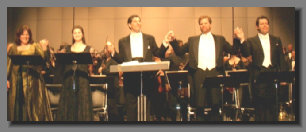
Left to right: Margaret Jane Wray, mezzo-soprano;
Michele Capalbo, soprano; Laurence Gilgore, conductor;
Michael Hayes, tenor and Philip Cokorinos, bass-baritone.
In an interview I had with conductor Laurence Gilgore a few days before the
concert I asked him how he intended to interpret Verdi�s score. He bristled,
gently and said he didn�t intend to interpret it at all, but rather would
perform it, exactly as Verdi wrote and heavily annotated it, and he would defend
his strict construction of the score with orchestra, chorus, singers, and anyone
else who thought Verdi meant for his work to be �interpreted�.
Those who are familiar with the history of this Requiem, understand Maestro
Gilgore�s reasons for wanting to distance himself from those who took liberties
when it was first released.
On Saturday evening, March 19, 2005 at the Palace Theater in downtown Stamford,
Laurence Gilgore delivered on his promise to be true to the composer�s detailed
notes, and along with the resident orchestra of Connecticut Grand Opera and
Orchestra, a chorus of some 180 singers from the Mendelssohn Choir of
Connecticut , Choral Arts Society and the Fairfield University Chamber Singers,
combined with the superb and emotionally-driven performances of Michele Capalbo,
soprano; Margaret Jane Wray, mezzo-soprano; Michael Hayes, tenor, and Philip
Cokorinos, bass-baritone, delivered to the audience a performance that would
have made Verdi proud.
The advantage to listening Verdi�s Requiem with the orchestra out of the pit and
the chorus standing behind it on a plain stage, is obvious: the audience is
given the treat of hearing the full, rich, deep and majestic sounds of this
Requiem in an acoustically suited forum � instrument to ear. It is an experience
that can�t be duplicated even with the best sound system in one�s home or
anywhere else. Requiem has to be heard, or more appropriately, experienced, to
be fully appreciated, and the only way to experience the visceral emotionalism
of this work is to be there when it is performed.
From the ethereal pianissimo sound emanating from the bass, cellos and violins
in the first moments of �Requiem aeternam dona eis, Domine� � perhaps the most
beautiful and inspirational music ever composed -- to the forte, fortissimo of
the Day of Wrath in �Dies Irae�, perhaps the most disturbing, Maestro Gilgore,
in a studied, unhurried and confident manner guided the small army of performers
before him through what in lesser hands might have been a formulaic exercise �
the recital of the liturgy of a Requiem � into, instead, something bordering on
a rip-roaring spiritual revival.
The orchestra felt it, the chorus felt it, the audience felt it, and the
singers, most clearly felt it. When he wasn't singing bass-baritone, for
example, Philip Cokorinos sat with his eyes tightly closed and with brows
furrowed, he swayed ever so gently, imagining the score to himself - evidently
experiencing every moment just as we in the audience experienced it. He sang
with passion and obvious personal commitment to making every moment a meaningful
one, and he scored high on each effort.
Mezzo-soprano Margaret Jane Wry, her voice full, fluid and steady, darn near
levitated when she sang, and with soprano Michele Capalbo who displayed the
wonderful talent of being able to arrive at the highest of notes from nowhere,
concealing the beginning of sound behind a Cheshire expression that said the
voice would follow only when she commanded it, delivered their parts with expert
control and tons of humanity and soulfulness. For his part Michael Hayes,
singing tenor, is quickly evolving into a charismatic personality on stage who,
when he calls on the lyric tenor that is there, emotes a quality of sound that
is crisp and powerful without being overbearing or shrill and a stage presence
that says, "look to me". Semper Fi, Michael! All in all, this was a fine cast
with a mission to achieve, and the talent to deliver effortlessly, as they
clearly did. Maestro Gilgore said he would select his singers carefully. He did,
and the rewards for those in the audience were enormous.
Requiem is comprised of a score written for many participants, not the least of
which is the chorus which gets a chance to explore its own reasons for being
with enough space around it that it is able to add not just background, but as
was done time and again Saturday evening, actually drive the deepest emotional
moments of this Requiem with just the right mix of inspiration and fullness such
that the sound was both - in a whisper -- heavenly and -- in a shout --
threatening, depending on where Verdi wanted his audience to be at any given
moment in the piece.
I have listened to "Dies Irae" on CD from different orchestras in different
settings, and always found this part of Verdi's work to be the most
uncomfortably jarring - almost too loud for the piece. Last night, Maestro
Gilgore, who said he intended to push fortissimo when called for proved that
when done properly, it could be exhilarating. Indeed, if you don't think timpani
and bass drum can add anything to a piece, think again. The Day of Wrath came
alive, and in those bars when the two combined one after the other to emphasize
the stark reality of final judgment, the experience was breathtaking and
anticipated. It's a small thing, but to this reviewer it was going to be an
important standard by which I measured my own reaction to how well I thought it
was performed. I was knocked out!
Lastly, I can't say enough for this orchestra. Verdi's Requiem is a magnificent
piece of music and when done well and with love, it resonates with the kind of
passion and beauty that invokes the purest and most genuine reverence. When the
orchestra, chorus and singers were finished last night, we in the audience were
every bit as drained as they, for we were carried along by the music to the
alpha and omega of our own existence, and just as the music gave its own reason
for being, it gave each of us spiritually a sense of our own mortality, too.
This is what great performances are all about.
If I had one regret it would be this: the theater was not at capacity as it
usually is. For those who said, "Oh, the Requiem, I've heard it before", this
writer would add one caveat: never think you have heard a performance before, no
matter how many times you have heard it. There is always something different,
something new to experience when listening to a live orchestra and singers, and
last night's performance of Verdi's Requiem under the expert leadership and
caring attention to detail of Laurence Gilgore, was just such an occasion.
Stamford Advocate
CGO&O, Mendelssohn Choir deliver a Requiem to remember
By Jerome R.
Sehulster, Special Correspondent - Stamford Advocate
March 27, 2005
I've said in these pages that to hear a classically trained voice in song,
unsullied by amplification systems, is to get about as close to heaven as you'll
get while still on Earth. The Verdi Requiem, performed by the Connecticut Grand
Opera & Orchestra Saturday evening at the Palace Theatre, ample proof of this
contention, was heavenly. This Mass for the dead is really a hymn to the
glory of the human voice.
Verdi's Requiem is a composition for four soloists, large chorus, and orchestra.
He wrote it in 1874 to honor the anniversary of the death of Alessandro Manzoni,
who was, to Verdi and to many others, the summit of Italian culture. Sixty at
the time, Verdi was witnessing with regret the passing of a heroic age. His
reverence for Manzoni, and for all he represented, is felt throughout.
Verdi's long experience as a composer for the operatic stage is evident in every
page of the score, but here his hand is unfettered by character, scene or plot.
The soloists are voices, not kings or queens; the voices of the chorus are just
that, not villagers or courtiers. Musically, and also spiritually, the Requiem
is a deeply moving, soul searching work.
It was clear that CGO&O's Music Director Laurence Gilgore, in close
collaboration with Chorus Master Carol Ann Maxwell, prepared the massive score
with care. Immediately evident in the opening bars of the Requiem was close
attention to dynamic ranges and to the crucial blend of sound. The chorus and
orchestra begin with a barely audible whisper, eventually rising, in the Dies
Irae section, to maximum forte. The choral contribution from the joined forces
of the CGO&O Resident Chorus and the Mendelssohn Choir was mostly spectacular:
Their enthusiasm, their attention to mood and text, and their harmony were
conspicuous aspects of the success of the evening.
Gilgore's conducting evinced both his love and respect for this magnificent
score. The Connecticut Grand Opera Orchestra met the challenges set before them
with mostly winning results.
The four soloists were laudable, though each impressed for a different reason.
Mezzo soprano Margaret Jane Wray had not only the rich, deeper notes for her
part, but also a finely honed edge on the top of her voice that cleanly cut
through the sound of the hundred-plus others on stage. But, as important, Wray
always connected with her words. Her eyes, as much as her voice's inflections,
communicated volumes, particularly in the Liber scriptus. I have read about the
directions her career is taking. Hearing her in this, I have no trouble imaging
Wray developing into a very fine Isolde down the road. I'd look forward to being
there.
Connection and communication: The same can be said for basso Philip Cokorinos,
whose excellent Sparafucile energized this past November's performance of
Verdi's "Rigoletto." His was a face of anguish as he expressed the Confutatis
maledictis in the Dies Irae. Cokorinos continued to impress throughout the
Requiem.
Tenor Michael Hayes had a rather thrilling tenor sound that rang out over the
assembled forces. Missing, I thought, were the subtleties in dynamics and in
ornamentation, especially in his Ingemisco. The notes were there, certainly, but
one wanted more attention to the shadings. When push comes to shove, however, I
applaud his range, his intensity and the overall clarion quality of his voice.
I found Michele Capalbo's performance of the soprano part of the Requiem very
moving. At all times Capalbo brought a totally satisfying control to her
instrument, from sustained pianissimi to rock solid fortissimi, with some lovely
demonstrations of messa di voce in between. The Agnus Dei, a duet for Capalbo
and Wray, was quite entrancing.
The real test of a soprano's mettle in the Requiem is the concluding Libera me.
At several points therein she has to work hard to be heard over a full chorus
and orchestra, but then, in between these titan efforts, she is asked to float,
exposed and alone, a gracefully and softly sustained high note. I enjoyed the
overall pleasure of Capalbo's sound, her placement of the voice, the attacks;
but, as much, I appreciated the visible effort, the involvement, and the
artistry that went into every moment of her performance. One hopes to see this
young artist on the stage of the Palace again.
Copyright � 2005, Southern Connecticut Newspapers, Inc.



